

review
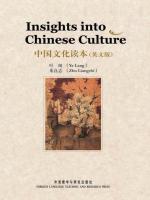
Insights into Chinese Culture, written by Ye Lang and Zhu Liangzhi, is an English-language introduction to the core ideas and aesthetic traditions of Chinese culture. The book is designed for international readers and Chinese students learning to express Chinese culture in English. Rather than presenting culture through historical facts or political narratives, the authors focus on the spiritual and philosophical foundations that shape Chinese ways of thinking.
A major strength of the book lies in its thematic structure. The authors organize the content around key cultural concepts such as harmony between humans and nature, moral self-cultivation, and aesthetic awareness. By doing so, the book helps readers understand Chinese culture as an integrated system of values rather than a collection of customs. This approach is especially useful for English majors, as it provides conceptual language that can be applied in academic writing and cross-cultural communication.
The book draws heavily on traditional Chinese philosophies, particularly Confucianism, Daoism, and Buddhism. Important ideas such as ren (benevolence), li (ritual), and harmony (he) are clearly explained and connected to Chinese literature, painting, poetry, and calligraphy. Through these examples, the authors show how philosophical ideas influence daily life and artistic expression. This connection between abstract thought and concrete cultural practice makes the content more accessible to undergraduate readers.
Another notable feature is the book’s English expression. Although it discusses abstract philosophical ideas, the language is generally clear and formal, making it suitable for classroom reading. For English majors, the book is particularly valuable as a model of how Chinese cultural concepts can be accurately and appropriately expressed in English. It also helps students develop cultural confidence when introducing China to a global audience.
However, the book mainly focuses on traditional culture and offers limited discussion of modern social issues or popular culture. Some sections may feel theoretical, especially for readers without a background in Chinese philosophy. Nevertheless, this depth also makes the book academically meaningful and suitable for higher-level reading.
In conclusion, Insights into Chinese Culture is a well-structured and insightful introduction to the core values of Chinese civilization. It is especially recommended for undergraduate English majors who wish to improve their understanding of Chinese culture and learn how to present it effectively in English. The book not only enhances cultural knowledge but also supports the development of cross-cultural communication skills.

 京公网安备 11010802032529号
